
Prediction Errors and Optimal Functioning
Our body's optimal functioning- insights from Kamin's blocking effect and Rescorla-Wagner model

Learning is minimizing prediction errors
Classical conditioning, or any learning mechanism, is a mechanism of prediction. When you ‘learn’ something- say when you learn not to take that creaky step on a staircase that always twists your ankle- your brain is minimising prediction error. Let me explain.
When you first put your foot on a step that has a little creak you are unaware about, you’re expecting to land your foot smoothly and continue running upwards. Instead, you trip! This is not very rewarding for your ankle, and you are now in pain. Something unexpected happened. Your body had made movement-calculations such that you’d have a perfect landing on all the steps of the staircase, because your body expected so. But that one step got you, and you ended up twisting your ankle. There was an error in what you predicted (smooth landing) and what actually happened (ankle trip)- and this was not very pleasant. Say this happens thrice (ouch). Your learning/prediction system is built so strong that by the third or fourth time you climb the same step, you would have learnt to either skip it, or tread on it more carefully. You expected the step to have a creak and for your ankle to trip, and you modified your behaviour accordingly. This is when there is 0 prediction error between what you predicted and what happened, and you have successfully learnt or modified your behaviour in a way that guarantees your survival!
This fascinatingly happens with you every day, with more things than you can imagine. You are constantly learning things. Your body is always expecting and predicting things at the back, checking against the real world to see whether they happen or not, and then constantly modifying its behaviour to ensure optimal functioning for you.
PS: next time someone tells you to ‘stop expecting things’- tell them you literally evolved to set expectations!
Does this actually happen inside our neurons?
Yes!
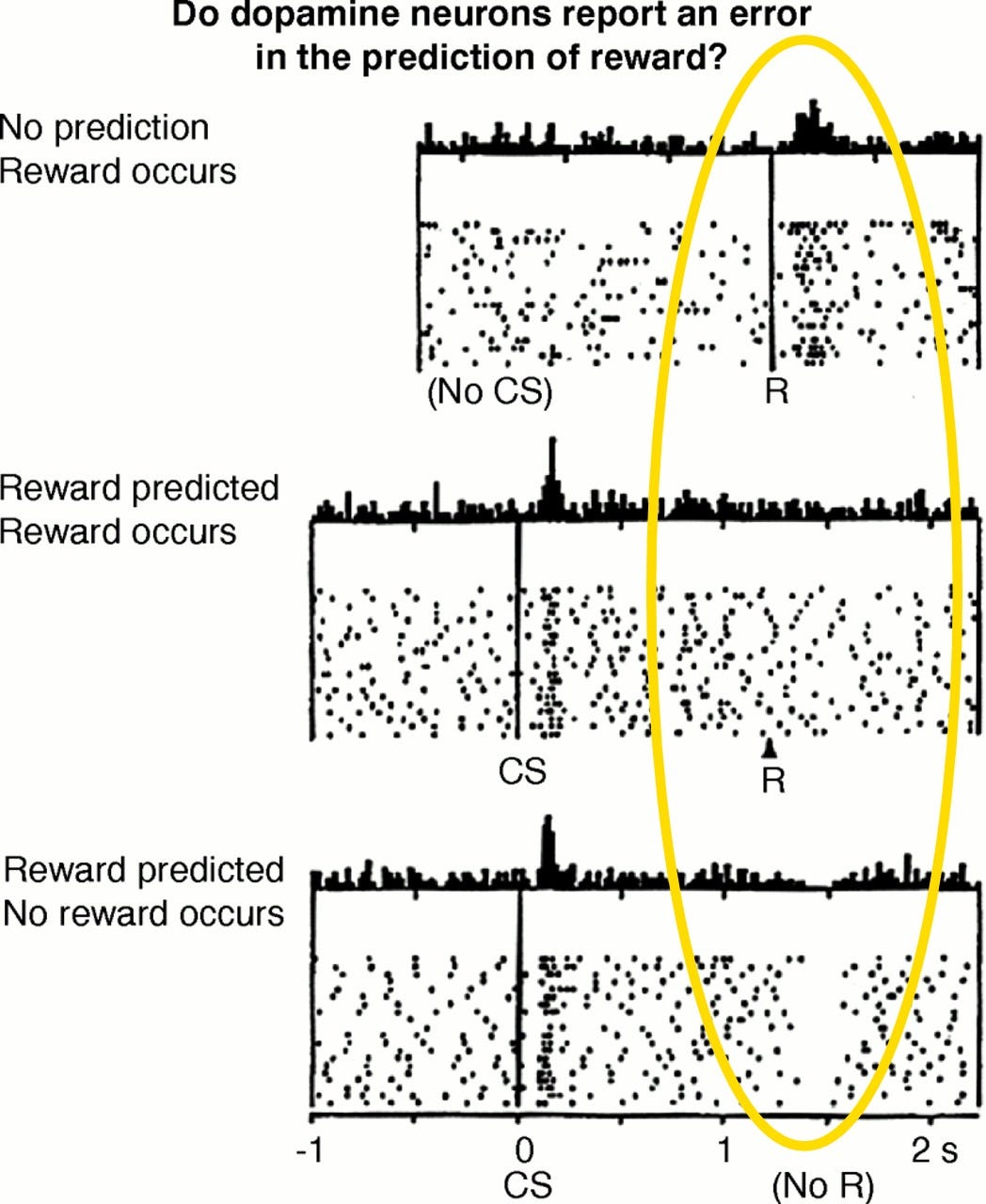
A) Juice (US) → dopamine neurons fire after receiving juice, because they did not expect it to come, but it did and was pretty delicious. Positive prediction error.
B) Tone (CS) + Juice (US) → dopamine neurons do not fire after receiving juice, because they expected it to come, and it did. 0 prediction error.
C) Tone (CS) → dopamine neurons show a dip after not receiving the juice, because they expected it to come, and it did not. Something worse than expected occurred. Negative prediction error.
What does your system predict? And with what?
Generally speaking— just about anything that helps you survive better can serve as the unconditioned stimulus. In my last blog, we saw how I got conditioned to studying, perhaps just because each study session fulfilled my personal goals and how I felt accomplished after every session. Your body can predict the smallest of things that give you comfort and learn to avoid all those things that give you even the slightest discomfort. At the end of the day, your body— your system, your brain— really wants to ensure your smoothest survival experience!
Great, but what are these predictors? What are these cues that actually tell us that the pleasurable or aversive situation is about to occur? Is there no restriction to that too— can just about anything be a cue? No.
In 1969, Kamin showed that if one cue is predicting the occurrence of an unconditioned stimulus fully, another cue will simply not. Your system will ignore it. This second unnecessary and irrelevant cue gets ‘blocked’, and this is known as Kamin’s blocking effect.
Your system runs optimally
Intuitively, Kamin’s blocking effect makes a lot of sense. You already know A is predicting B. If you add C as a cue on top of A, that will not mean anything to me. A is still predicting B, there is no prediction error here just because of the addition of C. The ‘surprise element’, so to speak, is missing!
In my opinion, this is a fascination to behold, because this means that the neurons in your body selectively and adaptively only fire at a cue when it is informational and relevant, and reject the rest, simply because it’s the most optimum way out. If one cue does the job of fully predicting the US, why even bother associating another cue— even if it occurs as many times as the first one in the following trials. Your body chooses the most optimum option to save as much energy as it can. This somehow strikes more intriguing and fascinating to me perhaps because I cannot fathom how the neurons just know which cues are informational and relevant and which are not simply based on prediction errors.
Think also of habituation- when a stimulus (weak by nature by default) is classified as harmless by our brain and is administered repeatedly, your neurons, again, start firing lesser and lesser, until there is no firing. Your neurons aren’t tired; they’re just saving energy because they know no harm is en route!
Interesting and informative.The choice of putting Phil Dunphy is questionable because he seems to be an exception to this 'learning' rule.